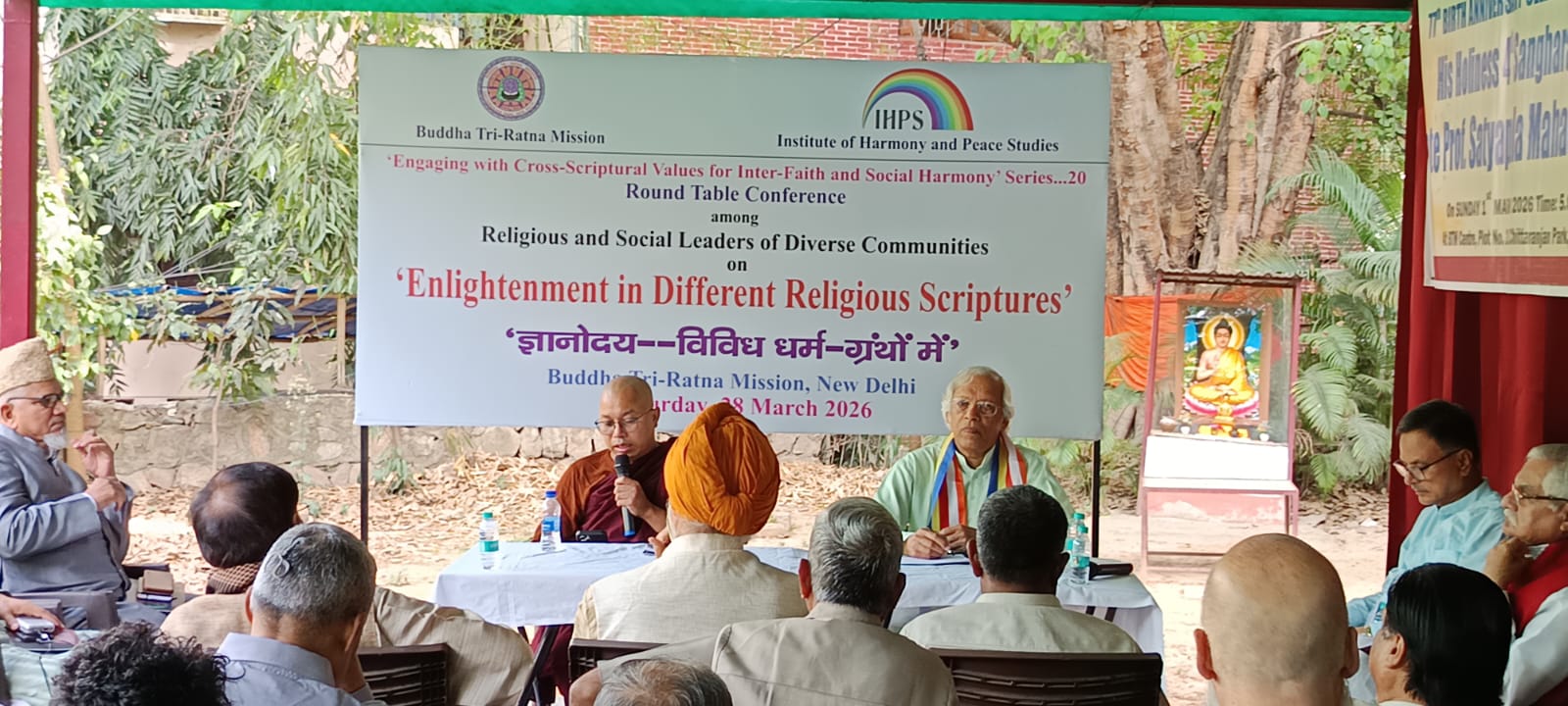
A ROUND TABLE CONFERENCE ON 'ENLIGHTENMENT IN DIFFERENT RELIGIOUS SCRIPTURES'
Institute of Harmony and Peace Studies (IHPS), New Delhi, in collaboration with Buddha Tri-Ratna Mission (BTM), New Delhi, organized a round table conference among Religious and Social Leaders of Diverse Communities at Buddha Tri-Ratna Mission, New Delhi, on 28 March 2026. The theme of the conference was ‘Enlightenment in Different Religious Scriptures’ (‘ज्ञानोदय--विविध धर्म-ग्रंथों में’). Fr Dr M. D. Thomas, Founder Director, Institute of Harmony and Peace Studies, New Delhi, chaired and moderated the session. Mr Subroto Barua, General Secretary, Buddha Tri-Ratna Mission, New Delhi, welcomed the participants at the beginning and proposed a vote of thanks at the end of the programme.
Prof. T. K. Mishra (Former Professor, Ramjas College, Delhi University), Prof. Junaid Haris (Professor, Department of Islamic Studies, Jamia Millia Islamia, Central University), Prof. Salim Engineer (Vice President Jamaat-e-Islami Hind), Dr Chand Bharadwaj (Founder Gyanam Suvigyanam), Dr Vic Gaffiney (CEO, Indian Institute of Leadership Sciences), Dr Gopal Jee (President, Global Yoga Alliance), Dr Ajay Jain (Founder Promoter, Jain World Mission), Adv. Monika Sharma (Advocate Supreme Court), Ms Nilakshi Rajakhowa (Director, Office of Public Affairs of the National Spiritual Assembly of the Baha’is of India), Arya Ravi Dev Gupt (President, Mat-Matantar Samanvay Samiti), Mr Aniruddh Kumar (Inter-faith Activist), Janab Ghulam Rasool Dehalvi (Sufi Scholar), Janab Firoz Bakt Ahmed ((Former Chancellor, Maulana Azad National Urdu University), Sardar Harvinder Singh Lamba (Member, Guru Tegh Bahadur Educational Charitable Trust), Sardar Surjit Singh Azad (Vice Chairman, Gurdwara Bangala Sahib), Mr Yash Dhamija (Inter-faith Activist), Bhikku Dr Nanda (Member, Buddha Tri-Ratna Mission), Mr Subroto Barua (General Secretary, Buddha Tri-Ratna Mission) and Fr Dr M. D. Thomas (Founder Director, Institute of Harmony and Peace Studies) were the speakers of the conference. Several people from diverse communities participated in the event, as well.
Fr Dr M. D. Thomas, in his opening remarks, explained that the seminar is part of the Institute’s ongoing series titled ‘Engaging with Cross-Scriptural Values for Interfaith and Social Harmony’. This initiative explores values from the sacred scriptures of different religions in a cross-cultural and comparative way. Dr Thomas emphasized that ‘Enlightenment,’ a core principle of Buddhism, is a universal value, greater knowledge and a shared heritage of all humankind. He urged participants to embrace this spirit, highlighting it as a key value that fosters harmony across religions. As part of the seminar’s dynamics, he encouraged speakers to identify and discuss similar values found within their own or other religious scriptures.
Continuing the programme, Bhikku Nanada explained that enlightenment in Buddhism (Bodhi or awakening) is the ultimate goal of spiritual practice. It represents a state of liberation from suffering, craving, and the cycle of rebirth (samsara). Enlightenment involves a direct insight into the true nature of reality—particularly impermanence, non-self, and the Four Noble Truths—and is achieved through meditation, ethical living, and wisdom. He further noted that enlightenment is marked by awakening, freedom from fetters, the cessation of suffering, and the cultivation of compassion and wisdom.
Dr Ajay Jain stated that, according to Jain scriptures, Keval Gyan (absolute knowledge) alone constitutes pure knowledge, and it is through this that enlightenment can be attained. He explained that the soul is inherently pure, but when covered by external layers, it loses its completeness. Jain philosophy identifies five types of knowledge: Mati Gyan (sensory or mental knowledge), Shrut Gyan (scriptural knowledge), Avadhi Gyan (clairvoyant knowledge), Manahparyaya Gyan (telepathic knowledge), and Keval Gyan (absolute knowledge). The attainment of Keval Gyan, he added, is possible through the observance of the five great vows.
Prof. Junaid Haris highlighted that, according to the Qur’an, Islam is founded on three core principles: Wahdat-e-Deen (unity of religion), Wahdat-e-Ilah (unity of God), and Wahdat-e-Adam (unity of humanity). These principles reflect the belief that the fundamental teachings of all religions ultimately lead to one supreme truth. He further emphasized that enlightenment can be attained through akhlaq (moral conduct).
Arya Ravi Dev Gupt remarked that human beings have been granted the freedom to think and act, and it is their responsibility to use this freedom wisely. Referring to the Vedas, he explained that knowledge is of two types: Nitya Gyan (eternal knowledge) and Naimittik Gyan (situational or occasional knowledge). While Nitya Gyan comprises daily practices essential for spiritual purity and discipline, Naimittik Gyan refers to specialized knowledge that helps individuals progress toward enlightenment.
Adv. Monika Sharma emphasized that enlightenment is essential for avoiding wrongful conduct. According to Hindu scriptures, attaining moksha (liberation) itself is enlightenment, which requires purity in thought, intention, and speech. She further stressed that while religious scriptures contain profound wisdom, this knowledge must be simplified for broader understanding and passed on to future generations to build a better society.
Sardar Harvinder Singh Lamba referred to the teachings of the Guru Granth Sahib, particularly the concept of Ik Onkar, which emphasizes the oneness of God and the unity of all humanity. He urged that we must not discriminate between ‘ours’ and ‘others’, and noted that enlightenment can be attained by understanding the Guru’s teachings and overcoming ignorance.
Prof. T. K. Mishra underscored the importance of awakening spiritual awareness among the youth, as it helps address mental distress. He emphasized the need to promote the shared values present in all religions, which foster tolerance and pave the way toward enlightenment. He also stated that sincerely fulfilling one’s duties is the highest form of dharma and a path to spiritual realization.
Mr Yash Dhamija highlighted the importance of understanding diversity, noting that differences do not divide us but enrich us. Referring to the Hindu philosophical principle of Neti-Neti, he explained that it guides individuals to transcend the transient and visible world in order to realize eternal truth, thereby making enlightenment possible.
Dr Vic Gaffiney stated that all human beings are children of the same God and that all religions represent paths toward the kingdom of heaven. He described true moksha as an eternal and irreversible state of liberation from the cycle of birth and death, signifying ultimate freedom and unity with the Supreme Being. He emphasized that humanity shares a common journey and that inner wisdom is essential for attaining enlightenment.
Dr Chand Bharadwaj introduced a philosophical perspective by speaking of ‘cosmic spiritual restructuring’, situating enlightenment within the broader context of human existence. He proposed that enlightenment is not merely a religious ideal but a fundamental right inherent to humanity. Using the metaphor of humans as ‘intelligent atoms’ originating from the Big Bang, he suggested that all creation is moving toward freedom. He also highlighted the recurring symbolism of light and sound across religious traditions as universal metaphors for transcendence.
Mr Aniruddh Kumar emphasized that all beings are interconnected through a universal energy. He stated that enlightenment can be achieved only by transcending the ego and fostering genuine connections with others, with the ultimate goal being unity with the supreme energy.
Janab Firoz Bakht Ahmed described such gatherings as sources of renewal in a world marked by conflict. He stressed the need for wisdom (Buddha) over war and urged individuals to uplift and support one another rather than belittle others, identifying this as the true path to enlightenment.
Sardar Surjit Singh Azad cited a verse from the Guru Granth Sahib: ‘Hum nahin change, bura na koi’ (I am not inherently good, and no one else is bad). He emphasized that instead of finding faults in others, we should cultivate the ability to recognize goodness, which forms the foundation of enlightenment.
Janab Ghulam Rasool Dehalvi emphasized the importance of diversity in contemporary society, comparing it to the harmonious coexistence of colors in a rainbow. He observed that although humanity shares a common divine origin, it has strayed from the values taught by the prophets, contributing to present global challenges.
Ms. Nilakshi Rajakhowa highlighted truthfulness as the foundation of all values that lead to enlightenment, describing it as a unifying ethical principle essential for both individual growth and collective harmony.
Prof. Salim Engineer explained that knowledge has two dimensions: one acquired through intellect, reasoning, senses, and experimentation, and the other revealed through prophets. He emphasized that knowledge becomes meaningful only when used for the benefit of others, as all ultimately return to the same Creator.
Dr Gopal Jee referred to the teachings of the Bhagavad Gita, noting that enlightenment leads to moksha. He added that this can be achieved through yoga, which emphasizes the unity of body, mind, and soul.
Concluding the session, Fr. Dr. M. D. Thomas emphasized the importance of applying enlightenment in everyday life. He urged individuals to move beyond the narrow confines of religion in order to truly practice its essence, stating that religion exists for human beings and is only one aspect of life—not its entirety. He cautioned against giving religion absolute importance and advocated for a balanced, moderate approach free from rigidity and extremism. He concluded that refining and elevating our understanding of religion is itself a form of enlightenment.
He further reminded the audience that nothing in this world is perfect, and therefore, we must embrace the good within religions while rejecting what causes harm. He encouraged an open-minded acceptance of noble values wherever they are found and emphasized that the true essence of faith lies in living its deepest principles. “Keep moving forward—that is the essence of life’, he concluded.